Dollars & Dragons

A newsletter and podcast focused on Friday Strout's fiction and tabletop roleplaying games. Featuring top industry contributors from both the professional Game Master scene, game designers, writers, artists, and more!

  • The Most Important Thing I've Made For Pro GMs

    Let me sell you on How To GM Romance (campaign live now!)

    Click here to get your copy!

    I’ve been a professional GM for 2.5 years. When I was new to the scene, often the more experienced professionals in the StartPlaying Games Discord would talk down to me or about my advice. They stopped doing that, largely, when I went full-time in 3 months. What I was doing was working – no one could argue with me on that point. The next major hurdle I had was convincing people that they were not writing effective ads.

    After organizing and running ad workshops for hundreds of pro GMs, I noticed some trends about not only their business but also how to deal with their players, community, and so forth. You might even say there was an underserved market (MBA term, heeeyy)! The most difficult aspect of this job for many of us is the expectation of customer service in a casual setting. This takes many forms: from responding to messages at all hours, to managing a table’s culture, maintaining a 24 hour notice policy for attendance, to anything a player can swing at you.

    Beyond those business considerations that I’ve covered in my newsletter, the biggest “table problem” was always romance. Such as:

    • A player did something without consent from another player and now you have a problem on your hands!

    • Your long-time player wanted to get married but you were unprepared, so the scene and romance fell flat.

    • Players had difficulty matching expectations with one another for a PC to PC romance.

    • You were unable to communicate where your boundaries were with a player.

    • Romance isn’t your specialty, so even though you really wanted to enable a player going on a date, you said no because you weren’t confident.

    • You didn’t know how to design an NPC for a romance, so you didn’t.

    • You felt overwhelmed by the amount of work involved in developing a romance, so you didn’t. There was no template or resource.

    Education is difficult as a medium to push. However, I have faith that as a subscriber to this newsletter, you believe in professional education and useful tools for GMs. I am so proud to be a part of this project How To GM Romance – it’s genuinely a dream come true that I’m in a position to lead it.
    As a game master, be you professional or hobbyist, you are in a position of power. It’s so important that you are educating yourself on how to best manage your table while building trust. Relationships – all of them – are about trust. With a thorough education about how you might try to approach romance in your games, you are giving yourself the best opportunity to be trusted by your players. In turn, that trust is going to build into a beautiful opportunity to share something powerful with them.

    If your players are not invested in your game, I would wager that a big reason for that is the lack of trust or respect in what you are trying to achieve. Many of the most “anti-romance” player I have met in my games, if they stuck around long enough, asked for some form of romance. Why? Trust.

    Yes, even an “off screen” romance is facilitation of romance. The expectation of romance for a GM is not a prescribed conclusion, a sex scene, or a saucy break-up – just as it would not be for any theme or plot. Being educated about romance does not mean you are going to railroad everyone into polycules. It just means that you are prepared.

    We run the game for the love of the game. Why not game with love, too?

    Please check out our Backer Kit campaign. With the support of this growing community, I hope to keep building tools for GMs. May this book be loved as intensely as the support you all have given me.
  • The New Way To Homebrew: Tabletop Mirror

    Check out this month’s sponsor!

    Our sponsor this month is Tabletop Mirror! Check them out in the video below or read the transcript. Sponsors help keep this newsletter and my podcast free! Please follow them on Backer Kit if it’s a service you’re interested in.

    I love improvising in my games and adjusting everything to fit the table so that I give my players a unique and memorable experience. The problem is the bookkeeping. I can’t even remember the last time I leveled up my party, let alone some obscure lore or tweaked magic item I gave them 10 sessions ago.

    And really: Homebrewing can be difficult not because the game itself is hard to learn, but because homebrewing into our tabletop programs or VTTs can only be accomplished with deciphering the complex code the website was written in.

    That’s not the case with Tabletop Mirror. If you need to create something, you just type it in plain text then you can link it through an easy-to-navigate database. It’s a game changer in terms of homebrew organization and development. Easy to share with your players, too.

    My favorite part about Tabletop Mirror is the fact that it makes the tedious bits of random facts easy to organize. Do you need a timeline and calendar? You’ve got it. Do you need to make your own map or upload something to scribble on? Covered. It also has a quick and straightforward battlemap and VTT system if you prefer to keep things in one window.

    Check out the link in the description to follow their Backer Kit campaign and start homebrewing with Tabletop Mirror.

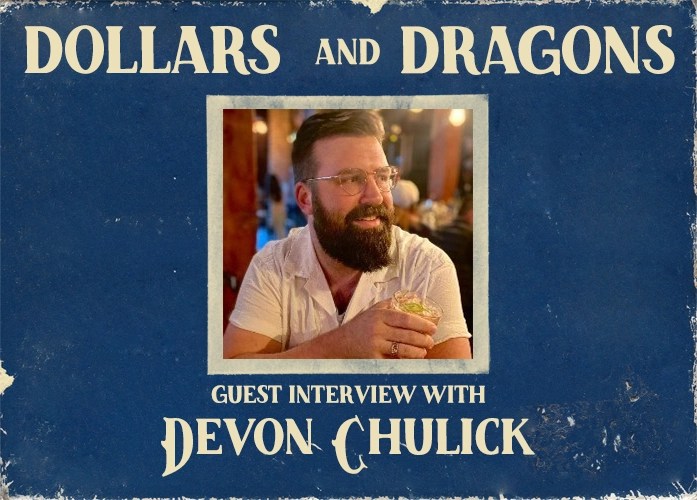
  • "StartPlaying Games in 2024" | Ep 46 – Devon Chulick (he/him)

    Dollars & Dragons Podcast

    This time we have the co-founder of Start Playing Games Devon Chulick. We talk about Total Party Chill, the SPG origin story, and what’s new with SPG. This was recorded earlier in the year, so some of the features may already be launched on SPG!

    Pro GMs… NO SERIOUSLY, TAKE THE ONBOARDING! https://calendly.com/game-master-onboarding

    Links:

    https://www.devonchulick.com/

    https://twitter.com/ttlprtychll

    https://www.youtube.com/@TotalPartyChill

    https://www.twitch.tv/totalpartychill

    If you’re a GM listening who struggles with romance and would like a great resource to be able to handle anything your players might throw at you – in a safe and comprehensive way – check out my new guidebook How To GM Romance.

    Your support means we can continue to make great resources for GMs to help you earn a living wage as a pro!

  • Vineyard RPG: Undead Gala nominated for an ENNIE!

    Not the email I thought I’d be sending

    Nominee_-_Gold_logo.png

    Hey y’all! I just wanted to pop in to let y’all know that we’ve been nominated for the 2024 ENNIES! If you’re interested in checking out the adventure itself, it’s on sale right now for $0.99 on Drive Thru RPG. Voting opens up next week with the winners announced at GenCon next month. I will be annoying and send a link to the voting when that happens.

    https://www.drivethrurpg.com/en/product/458097/Vineyard-RPG-The-Undead-Gala?affiliate_id=2822085

    My eternal thanks to my team! here is a flip through I did for the adventure if you are a GM and want to listen to me talk about the adventure itself. I made this back in November when we released the adventure. Wow I was excited about it then, too.

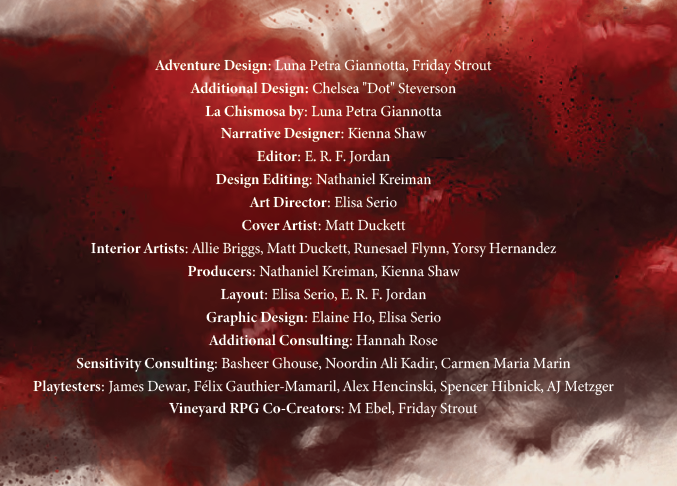
    Enthusiastic credit goes to my full team on this part of the book.

  • How To GM Romance

    Both a how-to and the upcoming guidebook!

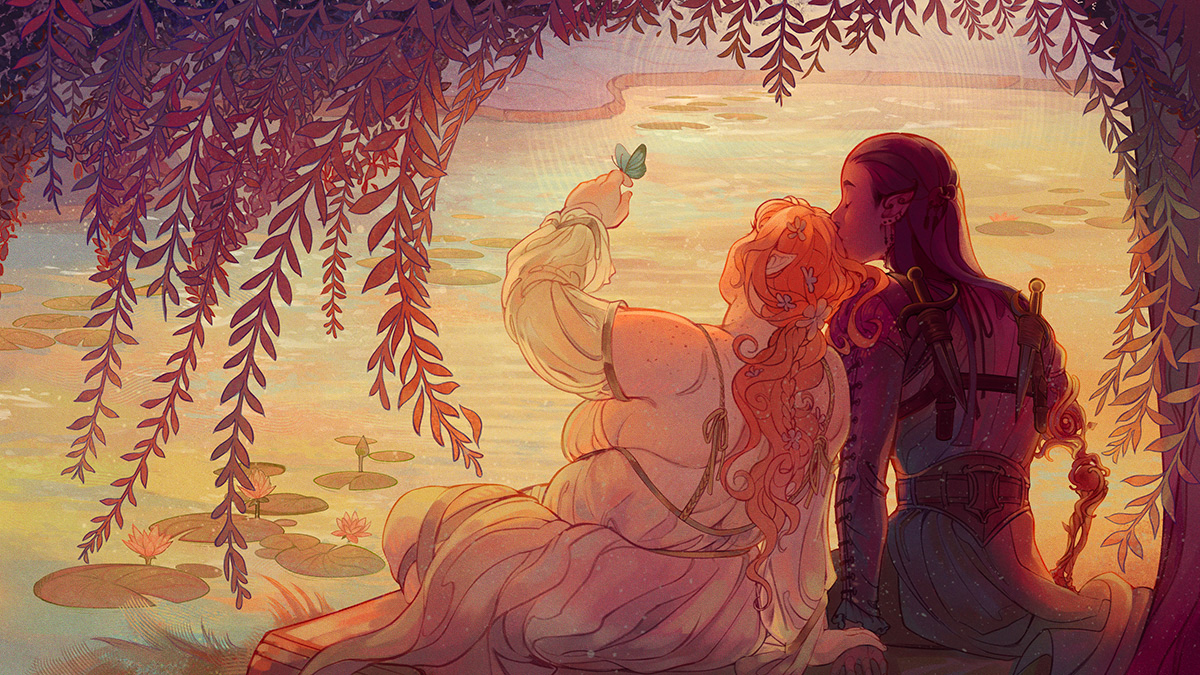
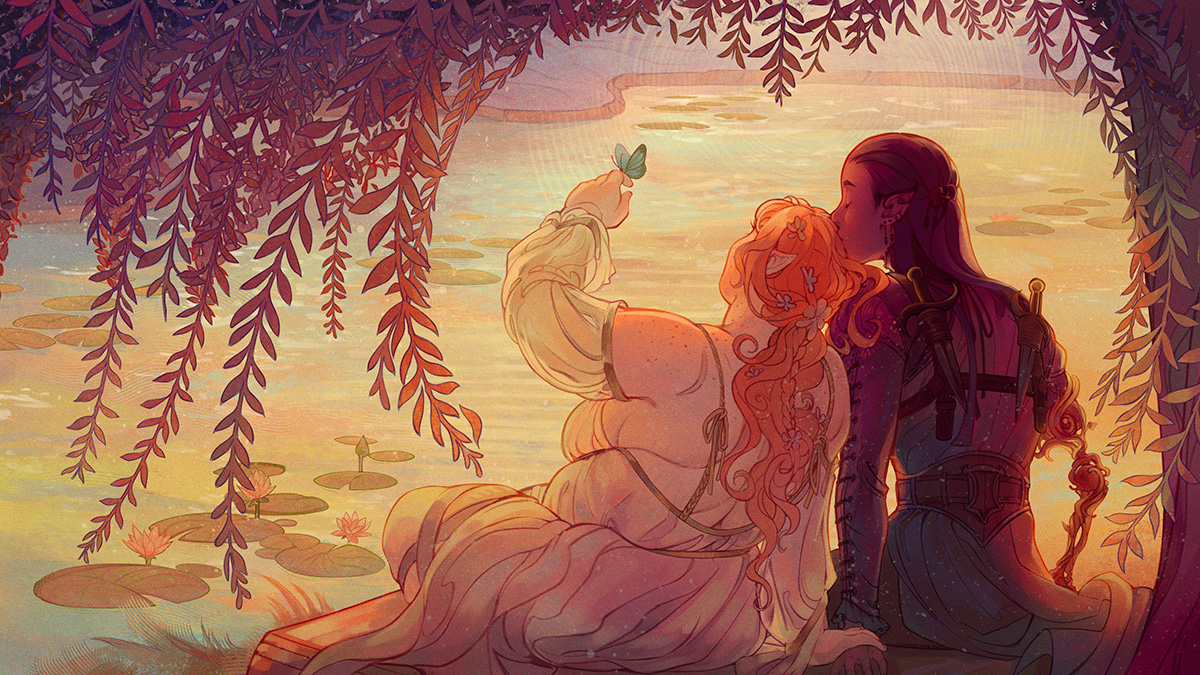
    GMing romance plots is dangerous. Just look at reddit or watch any YT videos about awkward D&D table issues. There’s so much that can go WRONG – yet it’s so EASY to get right. I run romance interests and plots for my players each week.

    Here’s how…

    Session 0 –

    You need to express expectations, lines, veils, and safety tools. You absolutely need an X (stop) and/or N (veil) card in play if you’re going to allow romance or intimate contact. People have a right to change their minds mid-game – allow them the space to.

    Start with your lines/veils and rules. I don’t allow myself to initiate with players as an NPC without consent. I’m in a position of power as GM, so it might be seen as something that “has to happen” in the context of a plot. That’s not true. So I eliminate the threat of it.

    Clarity –

    In that same vein, if a player initiates with me, I consider that to be temporary consent. My NPC will flirt back. If I feel uncertain, I will ask directly: “Is your PC flirting?” Sometimes the player will say “Oh! No.” That’s okay. People communicate differently.

    As a GM you need to be ready for that uncomfortable clarification. People at your table sometimes won’t feel comfortable expressing themselves unless prompted directly, in private or in public. Use your discretion for this.

    Temp Consent –

    If I have temporary consent, (they flirted with an NPC) I will check-in with the player post-session. “How was that? Did you have fun with this? Is this something you want to continue?” Again: consent is not something you gain once and have forever.

    Ask –

    If I ever feel as though I want to run a romance plot that involves their PC, I will ASK FOR PERMISSION explicitly to the player in a private message. This is to eliminate: Peer pressure, awkwardness, and potential embarrassment. If they don’t want it? I don’t either.

    Planning Romance –

    If I’m wanting to do a thing for story reasons I will plan a 4 plot point story arc.

    1. Initial awkward romance

    2. Serious confession

    3. Commitment/Conflict

    4. Resolution

    I check in privately at each stage. Usually after every session with romance, even.

    These can be fit in nicely during downtime usually or in conjunction with a major plot. These are “b plots” that you find in many series dramas. They’re meant to incite direct interest for short periods of time, but not be the main story. They can also humanize former antagonists.

    Value –

    What can romance plots do for your table? Well, for some players they are an important facet to what it is to be human. If you do this carefully and intentionally, you can really invest your players.

    Apologize –

    You’re going to make mistakes. Be ready to admit a mistake and listen to your players if they express discomfort. Your romance script is not as important as the safety of your players.

    Modify Memory –

    You might need to drop a plot. Someone could be having a rough time IRL. The romance could be stressful and not fun anymore. For any reason if a player wants to – I allow a player to X out of a relationship, vaporizing it. (As though it never existed.) It’s easier for me to cut out the problem than to lose a great player.

    What if you want more than this article can tell you? You’re in luck. We’re launching How To GM Romance soon! Check it out.

  • "MUDs, Pro GMing, and Tabletop" | Ep 45 – Donathin Frye (he/him)

    Dollars & Dragons Podcast

    I had the wonderful Donathin Frye (he/him) on for a very nerdy chat! We talk our roots in tabletop (which surprisingly was MUDs), tabletop design and getting started, some of Don’s work like the Fallout series, etc. Check out his work in the links below.

    https://donathinfrye.com/

    https://twitter.com/DonathinFrye

  • How To Convince Your D&D Table To Play Indie Games

    How do you convince players to play more?

    So you’ve got yourself a crew that you want to play with more. You’ve been playing with them a while and the energy is fantastic. They’re enjoying the game, too. At the end of the session they are breathing heavy, exclaiming, sharing their favorite moments, complimenting one another, etc. You’ve got the recipe for seeding a second game. But you don’t want to run just any game – you want to run something other than Dungeons & Dragons.

    It can be difficult to get others to commit long-term for something new, so you start small. Try these strategies to open up your players to the possibility of helping you grow and expand your business, within reason. Sometimes, you might only get a game or two extra out of it – but that’s not bad. That’s good! It’s 1-2 games you would not have had previously.

    Scaling takes time, effort, and you’re going to stumble a bit on the way. Build your new tables as solidly as you can to accident proof them. You have to be especially thorough in building your non-D&D game tables.

    First, let’s vet your player(s) that you are going to approach. Sometimes, this is the whole table – others, it’s only 1-2 players. If you approach the wrong people before they are ready or before they are open to the idea, you will not “close” with them (make the sale). That is okay – they can come around later as long as you are not pushy.

    Ideal 2nd Game Player:

    • Good attitude

    • Plays well with others and is charismatic

    • Roleplays to include others and helps others become more engaged

    • Provides you with feedback privately but is not rude

    • Helps out newbies

    If you have yourself one of these players, then this is a prime candidate for someone to seed your new game. From here, I always introduce a one shot or short campaign series to interrupt the current long-form campaign. e.g. We’re playing Curse of Strahd, and I run a 3 session campaign of HEART.

    I pitch it to my players. Here is how:

    The Indie Game Pitch

    • 1 Page Player Brief

    • YouTube vibe video (2-5m at most)

    • Pre-gen characters

    • Automation in your VTT if applicable (Foundry’s Pathfinder 2e)

    • A campaign you are excited to run

    Ideally you have felt things out with them for the game here and there. You’ve shared one or two things with them in your gossip period and they have expressed interest. Then, you drop the above proposal. If they accept, you post a new game listing, cancel the sessions scheduled for the block of time, and onboard your current players. You can either do this separately from the potential new joins (if your table isn’t full) or you can wait to do this on the first new session day.

    From there, you’ve already done all the hard stuff. If they love the new game, you will have a much easier time opening it up on a separate day and getting some of them to bite.

    Overcoming Objections

    Often people do not want to be sold to directly, so you have to be indirect about it. Therefore, you need to build a list of likely objections that they will have in order to resolve them before they come up.

    • Too expensive? (Charge the same price as your current game, unless you can justify a higher price.)

    • Not enough time? (Run it during your current session time for a short period. They may reconsider a second game after having a ton of fun playing it.)

    • Only like D&D? (This one is difficult to overcome, but you can try running D&D adjacent things or game systems that take less than 5 minutes to learn with pre-gens.)

    • Don’t want to learn a new system? (Automation, cheat sheets, pre-gens, everything that gets in the way of them having fun sooner rather than later.)

    Anyway, that’s that. Let me know what it is that you do to bring people in for indie games! Also, if you’d consider supporting me on Patreon, then you gain access to the exclusive pro GM community on my Discord who offers much better help than you find on the streets.

  • "TTRPG Discourse & Rascal News" | Bonus ep 6 – Lin Codega (they/them) & Rowan Zeoli (she/her)

    Dollars & Dragons Podcast

    This time on Dollars & Dragons we invited over our favorite rascals to talk about their new journalism website: https://rascal.news/ – make sure to support them by subscribing as they are 100% independent!

    We chat about TTRPG news, the culture of journalism, queer culture, white people, Twitter, diversity in projects, abusers in the industry, and radically loving others. Bonus content: Friday talks about a Grindr date.

  • Patreon Hosted Workshops for Pro GMs and Freelance Designers

    Free episode!

    Hey! I have just released a podcast of our workshop that I ran answering questions helping pro GMs and aspiring freelancers in TTRPG. Check it out here:

    https://www.patreon.com/posts/workshop-1-pro-100551424

  • "Freelance writing advice: I did not leave my desk for 30 days" | Ep 44 – Beth The Bard (she/her)

    Dollars & Dragons Podcast

    This time we had on Beth The Bard (she/her)! She is a game designer, publisher, and professional Dungeon Master. Her work includes She Is The Ancient, Fallout: The Roleplaying Game Settler’s Guide Book, Daughter of Frankenstein, and The Hourglass Coven.

    https://beththebard.com/

    https://ttrpguniversity.com/